Dual harmonic Kelvin probe force microscopy
What is DH–KPFM?
Dual Harmonic Kelvin Probe Force Microscopy (DH–KPFM) is an advanced Atomic Force Microscopy (AFM) technique designed to measure local surface potential. It allows simultaneous acquisition of topography and surface potential in a single-pass configuration, and can also be implemented in lift mode.
How does it work?
In DH–KPFM, an AC voltage is applied to a conductive AFM tip while the cantilever scans the sample in tapping mode. The resulting electrostatic interaction generates signals at two harmonic frequencies (ω and 2ω), which used to calculate the local surface potential.
Why use DH–KPFM?
DH–KPFM provides several advantages over conventional KPFM:
Operation in liquid – no DC bias is required, avoiding electrochemical reactions and ion redistribution.
Extended voltage range – capable of measuring surface potentials far beyond the ~10 V limit of conventional KPFM.
Suitable for DC-sensitive materials – eliminates issues such as bias-induced reactions.
Open loop operation – relies only on AC excitation, removing instabilities from feedback loops.
Improved lateral resolution – performed without a lift height, keeping the probe closer to the surface and minimizing long-range averaging.
Typical Applications
Electrochemistry at solid–liquid interfaces
DH–KPFM enables quantitative surface potential mapping in liquid. Here, DH–KPFM has been used to compare graphene on copper in air and in water, revealing consistent CPD values for graphene across environments while highlighting shifts in copper due to corrosion processes. (Fig. 1) This demonstrates its power for studying electrochemical phenomena at interfaces relevant to energy storage.High-voltage and pyroelectric measurements
By employing stiffer cantilevers with optimized AC excitation, DH–KPFM can measure surface potentials far beyond the 10 V limit of conventional KPFM. Here, DH-KPFM is demonstrated to monitor the surface potential with respect to temperature of LiNbO₃. This capability opens new opportunities for nanoscale studies of ferroelectrics, pyroelectrics, and other high-potential materials.
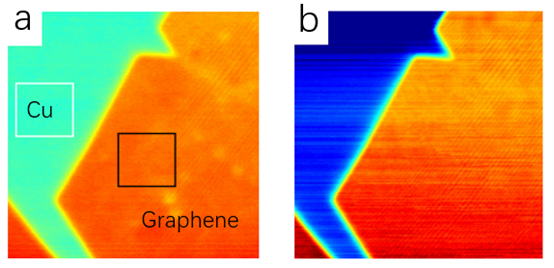
Fig. 1. Surface potential single layer graphene on Cu foil in (a) air and (b) water.
References
Kelvin probe force microscopy without bias-voltage feedback. Takeuchi, Osamu, et al.. Japanese Journal of Applied Physics 46.8S (2007): 5626.
Nanoscale potential measurements in liquid by frequency modulation atomic force microscopy. Kobayashi, Naritaka, Hitoshi Asakawa, and Takeshi Fukuma. Review of scientific instruments 81.12 (2010).
Dual harmonic Kelvin probe force microscopy at the graphene–liquid interface. Collins, Liam, et al.. Applied physics letters 104.13 (2014).
Dual harmonic Kelvin probe force microscopy for surface potential measurements of ferroelectrics. Collins, Liam, et al. Proceedings of ISAF-ECAPD-PFM 2012. IEEE, 2012.
Quisque iaculis facilisis lacinia. Mauris euismod pellentesque tellus sit amet mollis.